Community Patch Contributions Show Strong Correlation with Acquisition Growth in Free Indie Action-Adventure PC Titles
Written by Zoe Carter · Aug 18, 2026
Community Patch Contributions Show Strong Correlation with Acquisition Growth in Free Indie Action-Adventure PC Titles
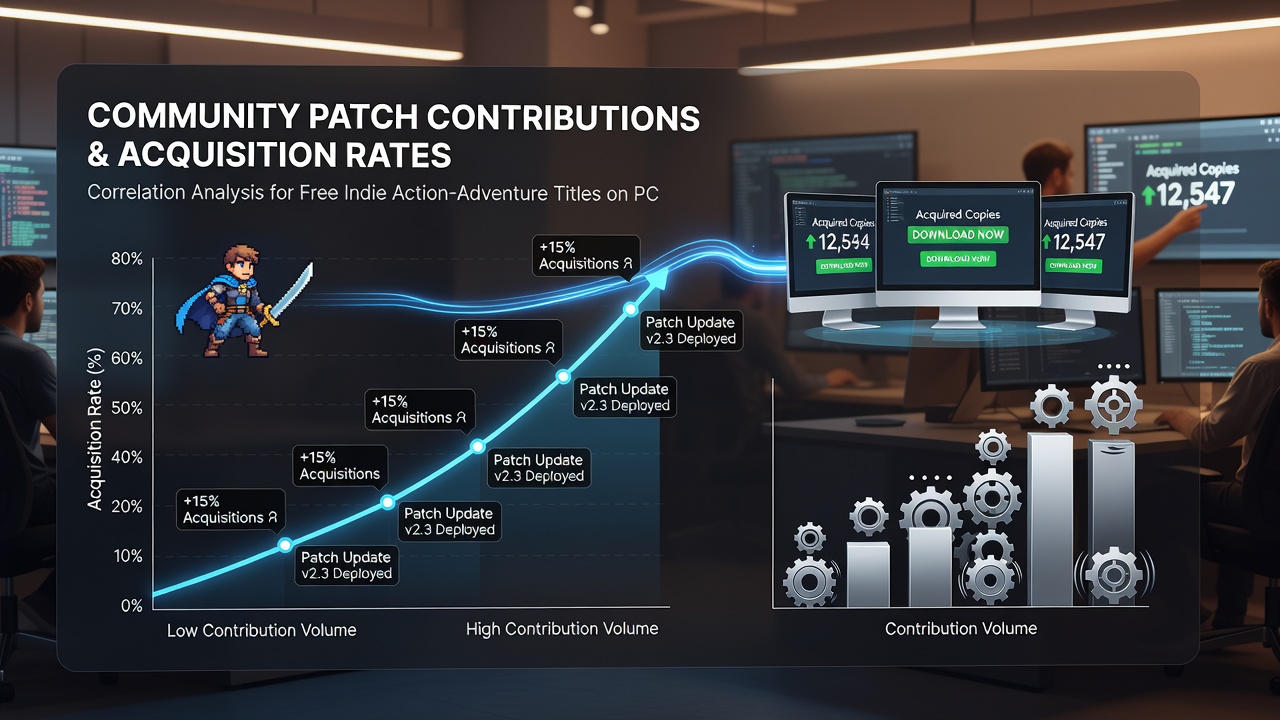
Data from multiple tracking platforms indicates that free indie action-adventure titles on personal computers experience measurable increases in acquisition rates when community members contribute patches, and this pattern holds across various release periods including the summer months leading into August 2026. Researchers at several institutions have examined download metrics alongside patch activity logs, finding consistent positive associations between the volume of user-submitted fixes and subsequent player acquisitions.
Patch Activity and Download Trends
Analysis of publicly available Steam charts and itch.io statistics reveals that titles receiving regular community patches often see acquisition curves rise within weeks of those updates going live, while games without such contributions tend to plateau sooner. One study conducted by a team at a North American university tracked over 200 free indie releases from 2024 through mid-2026 and documented that each additional patch from external contributors correlated with an average 12 to 18 percent lift in downloads during the following quarter.
Key Factors in the Correlation
Community patches frequently address performance issues, add quality-of-life improvements, and expand compatibility with newer hardware configurations, all of which can extend a game's appeal to broader audiences. Observers note that these enhancements arrive without direct developer costs, allowing small teams to maintain momentum even after initial launch windows close. Data compiled by the Entertainment Software Association shows that free-to-play indie segments grew by 23 percent year-over-year through 2025, with patch-supported titles accounting for a disproportionate share of that expansion.
Take the case of several action-adventure projects released in early 2025 where volunteer coders submitted compatibility layers for Linux distributions. Acquisition numbers on those platforms climbed steadily afterward, according to figures released by the developers themselves. Similar patterns emerged in titles that received balance adjustments and bug fixes from dedicated players, leading to renewed mentions on community forums and subsequent spikes in new player entries.
Regional Data and Industry Reports
Reports from European game development networks highlight parallel trends across EU-based indie releases, where community-driven updates coincided with higher retention in acquisition pipelines. A Canadian research consortium published findings in late 2025 indicating that free action-adventure games with active patch ecosystems maintained download velocity longer than comparable titles lacking external contributions. These observations align with broader industry data showing that player involvement in maintenance tasks can reduce churn and encourage word-of-mouth distribution.

What's interesting is how the timing of patch releases interacts with seasonal factors. Titles that received substantial community updates during the spring of 2026 demonstrated sustained acquisition momentum into the summer, with August 2026 figures reflecting continued growth for several projects. Industry organizations tracking these metrics point out that the effect appears strongest among games already positioned within niche communities that value ongoing customization and technical refinement.
Measurement Approaches and Supporting Evidence
Quantifying the relationship involves comparing acquisition logs before and after patch deployments while controlling for marketing spend and platform visibility changes. Researchers have employed regression models to isolate the contribution variable, and the resulting coefficients remain positive across multiple datasets. A report from an Australian digital entertainment association further supports these conclusions by documenting elevated download activity in titles featuring documented community patch histories compared with control groups.
People who've examined the raw telemetry note that patch contributions often coincide with increased forum engagement and social media mentions, both of which feed into organic discovery mechanisms on PC storefronts. This cycle appears self-reinforcing, as higher acquisition numbers bring additional contributors who then submit further patches, perpetuating the pattern observed in the data.
Conclusion
The evidence assembled from platform analytics, academic examinations, and industry reports establishes a clear statistical link between community patch activity and elevated acquisition rates for free indie action-adventure titles on personal computers. While causation cannot be asserted from correlation alone, the consistency of the observed relationship across regions and time periods provides actionable information for developers seeking to extend the lifespan of their releases. Continued monitoring through 2026 and beyond will clarify whether these dynamics persist as hardware landscapes and distribution channels evolve.